Why you can't hire your way to AI capability

Every business wants more AI capability. Most are trying to buy it, and the market is making that expensive and slow.
AI skills are now the hardest thing to recruit for. In ManpowerGroup's 2026 Talent Shortage Survey of 39,063 employers across 41 countries, AI skills overtook engineering and traditional IT to become the capability employers struggle most to find, with 72% reporting difficulty filling roles. The World Economic Forum put a sharper edge on it in October 2025: 94% of leaders reported shortages in AI-critical roles, and around a third said the gap ran to 40 to 60 per cent of the talent they needed.
The shortfall is close to home, too. Bain & Company estimated in March 2025 that the UK could face an AI talent shortfall of more than 50% by 2027, with roughly 105,000 available AI workers for as many as 255,000 open roles. Even a perfect recruitment process cannot fill jobs when the people simply are not there.
Even when you find them, the maths is unkind
Scarcity has a price. Bain found that pay for AI skills has risen about 11% a year since 2019, while postings for those roles grew around 21% a year over the same period. PwC's 2026 Global AI Jobs Barometer, drawn from more than a billion job adverts, put the current wage premium for AI skills at 62%, up from 57% the year before.
There is a second problem underneath the cost. The skills themselves keep moving. PwC found that the skills employers ask for are changing far faster in AI-exposed roles than elsewhere, and that demand for formal degrees in those roles is falling as employers hire for demonstrated ability instead. An Oxford Internet Institute study of more than 10 million UK job adverts, published in March 2025, found the same shift, with the share of AI postings requiring a degree dropping between 2018 and 2023. A specialist who is current today can be behind within a year without continued investment. As PwC's Peter Brown put it, this is "not a situation that employers can easily buy their way out of."
A few specialists do not spread capability
Even a successful hire solves a narrow problem. The capability most organisations actually need is spread across the teams that already understand the business: the finance team working with real revenue and cost data, or the manager deciding what to automate and what still needs a human eye. Dropping a machine learning engineer into that picture does not give a finance analyst the judgement to use AI well on their own work.
The World Economic Forum and ManpowerGroup point to the same response. The people who know your context, your data and your customers are already on the payroll. What they lack is a structured way to become genuinely capable with AI on the work they already do.
Generic training leaves a gap of its own
The usual alternative is to buy off-the-shelf training. It is easy to roll out and it does move people through content. The difficulty is that a course built for everyone rarely matches the work any one person does. Someone can finish it and still be unable to build something useful with their own data, in their own tools, under their own constraints. Capability comes from applying AI to real work under real conditions, with support when it gets hard.
What building capability actually looks like
This is the gap Etiq is built to close. Etiq is an AI reskilling platform that builds practical capability in your existing teams, mapped to the roles they actually hold.
It starts with the person. Their role, department, experience and goals shape a learning pathway made for them, rather than a single course pushed to the whole organisation. From there, they learn by doing. In an applied build environment, people create real AI-powered workflows using your company's own context and processes, with an AI tutor coaching them through their prompts and outputs as they go. A finance insights manager might build a monthly KPI commentary assistant against real numbers, and come out of it able to do the work themselves.
Because the platform runs on your own LLM keys and can deploy in your environment, your data stays where it belongs. And because progress is measured through the work people produce, leaders get a clear view of readiness and where the real gaps sit across teams and departments.
Run the numbers before you write the job spec
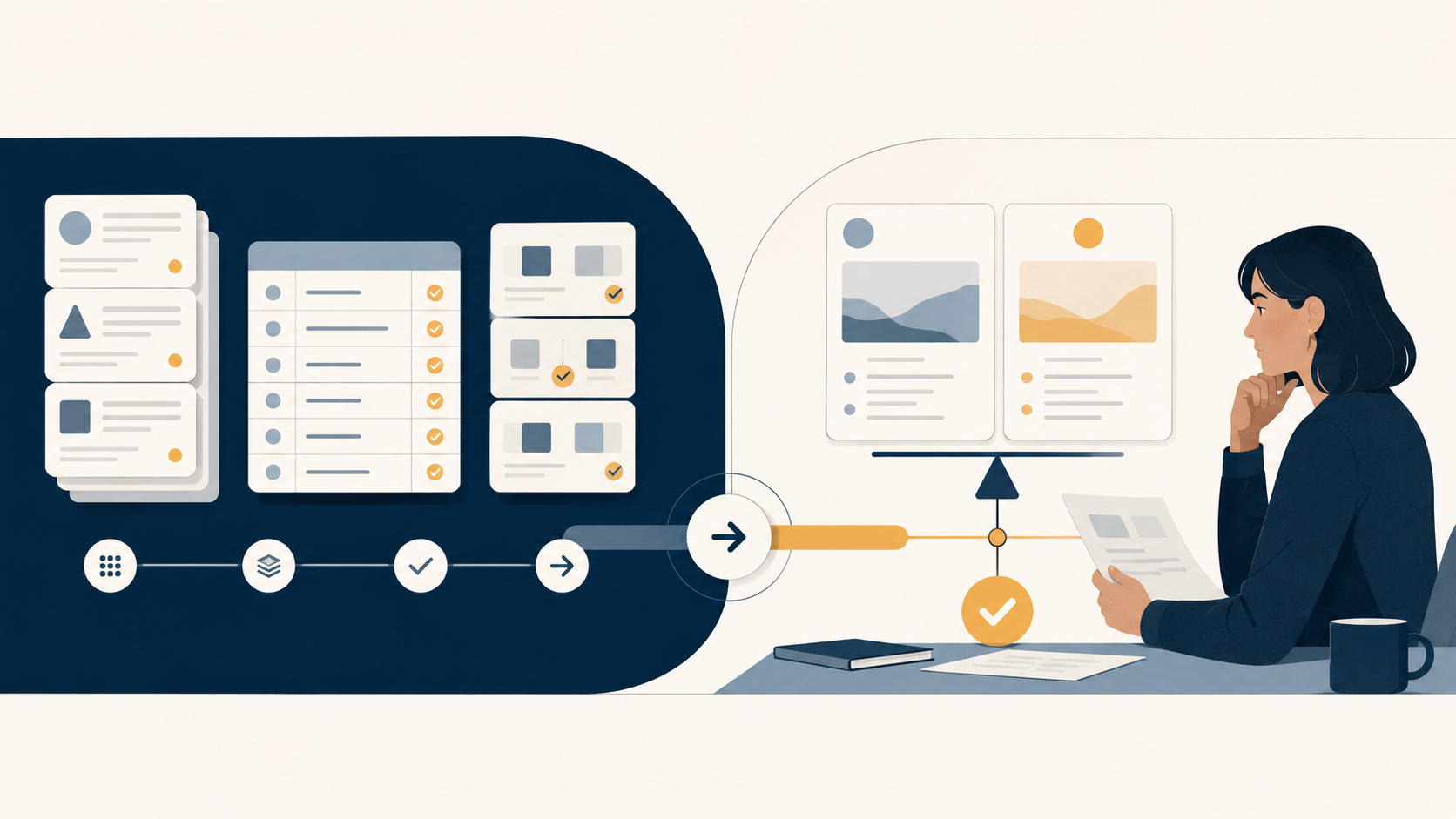
Reskilling and hiring both cost money, and it is worth doing the arithmetic before you commit to either. That is what Etiq's cost simulator is for.
You enter what a hire would involve: the role, seniority and budgeted salary, how long it takes to hire and to reach full productivity, the recruitment and onboarding costs, and the probability the hire works out. Then you enter the equivalent for developing someone you already have: their salary, the length and cost of training, mentoring, and the time until they are fully productive. The simulator sets the paths side by side, including a route through a traditional training provider, and shows you the hiring cost, the reskilling cost, the potential saving, the difference in time to productivity, and a risk-adjusted view that accounts for hires and training programmes that do not land.
It will not tell you never to hire. Sometimes a hire is the right call, and the tool will show you when. What it gives you is an honest comparison for your specific role, in your currency, on your own assumptions.
Run your own numbers at simulator.etiq.ai.