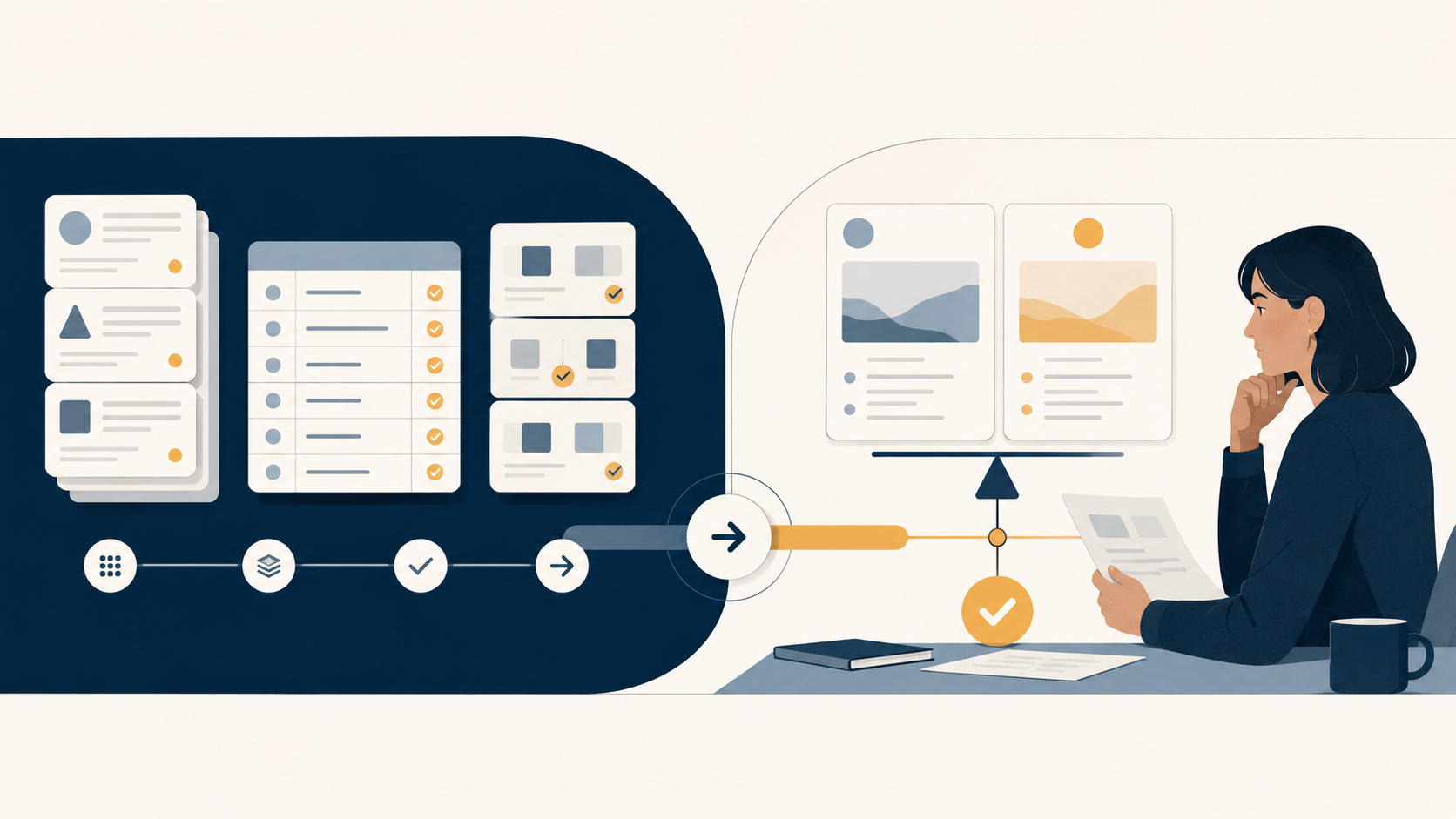
7 Checks Before AI-Assisted Work Reaches a Client

AI can help accountancy firms research technical questions, analyse financial data, draft reports and prepare client communications. It can also produce an answer that reads well while relying on the wrong tax year, misinterpreting a spreadsheet or inventing a plausible-looking source.
The person reviewing the work remains responsible for the final output.
Current professional guidance reflects this. ICAEW’s 2026 guidance on AI and accountancy says AI can support professional work, but does not replace professional judgement. Accountants are still expected to understand the output, challenge it and check that current tax rules, thresholds and reliefs have been applied correctly. Source: ICAEW
That review needs to be more substantial than reading the final document for obvious mistakes. Before AI-assisted work reaches a client, the reviewer should be able to answer seven questions.
1. Traceability: can every important claim be traced?
Start with the figures, facts and statements that could affect the client’s decision.
Each one should lead back to one of the following:
- information supplied by the client;
- a calculation based on identified client data;
- current legislation or official guidance;
- a named, accessible external source;
- an assumption that has been clearly labelled as such.
A citation generated by an AI tool is not evidence on its own. The reviewer needs to open the source, confirm that it exists and check that it supports the specific claim being made.
Traceability also applies to numerical work. If a report states that costs increased by 14%, the file should show which periods, accounts and adjustments produced that figure. A reviewer should not have to reconstruct the reasoning from the final paragraph.
This is particularly important where AI has combined several sources. A fluent summary can conceal an unsupported connection between otherwise accurate facts.
Before approval, ask:
- Can I identify the origin of every material figure?
- Have I opened and checked every important source?
- Are assumptions separated from verified facts?
- Could another reviewer reproduce the conclusion?
If the answer is no, the work is not ready.
2. Currency: is the information current?
Tax work is unusually sensitive to dates. A correct answer for one tax year may be wrong for the next because a threshold, rate, allowance, relief or reporting requirement has changed.
AI systems may use outdated material, miss a recent amendment or combine rules from different periods. ICAEW warns that generative AI tools may not have access to the latest legislative developments. Its guidance expects accountants to understand this limitation and apply professional scepticism when reviewing outputs. Source: ICAEW
Check the effective date of every rule used in the work. Confirm that it applies to:
- the correct tax year or accounting period;
- the client’s location and legal status;
- the relevant transaction date;
- any transitional arrangements;
- the specific relief or exemption being considered.
Where timing is significant, include the relevant date or period in the final advice. “The annual allowance is…” is less useful than “For the 2026/27 tax year, the annual allowance is…”.
HMRC’s current Standard for Agents expects tax advisers to maintain correct and up-to-date knowledge in the areas of tax they handle. It also requires reasonable steps to ensure that third-party inputs, including software, produce accurate results and comply with the client’s tax obligations. Source: HMRC
Using AI does not reduce that obligation.
3. Task fit: did the AI answer the right question?
An output may be technically sound and still be unsuitable for the client.
The AI might explain the general tax treatment while overlooking the client’s ownership structure. It might prepare a cash-flow commentary without recognising that a large payment was exceptional. It could answer the wording of a prompt while missing the decision the client is actually trying to make.
Review the output against the original instruction and the client’s circumstances:
- What question was asked?
- What decision will this work support?
- Which facts about the client could change the answer?
- Did the output stay within the agreed scope?
- Has anything relevant been assumed rather than confirmed?
This check requires subject knowledge. A reviewer needs to recognise when an answer is incomplete, even if everything included in it appears reasonable.
Client context should be visible in the work. If the same output could be sent unchanged to any client, it may not have considered the engagement closely enough.
4. Data handling: were the calculations and transformations correct?
AI-assisted analysis can fail before the written output is produced.
A formula may exclude a row. Dates may be interpreted using the wrong format. A filtered spreadsheet may omit a category. Currency values may be converted twice. Monthly and annual totals may be compared without adjustment. Negative figures may be treated as positive because their accounting presentation was misunderstood.
Reviewing the prose will not identify these errors. The data process itself needs to be checked.
For any material calculation or transformation, confirm:
- which file and version were used;
- whether all required records were included;
- how missing values and duplicates were handled;
- whether filters, joins and classifications were correct;
- which formula or method produced the result;
- whether totals reconcile with the source system;
- whether units, currencies and reporting periods are consistent.
Reperform critical calculations independently where practical. For larger datasets, use control totals, samples and exception checks.
The level of review should reflect the possible consequence of an error. A draft meeting summary and a tax calculation do not need identical controls.
5. Confidentiality: was client information handled appropriately?
Before reviewing the answer, establish whether the data should have entered the tool at all.
Staff should only use AI systems approved by the firm for the type of information involved. Approval should consider how the provider stores prompts and files, whether inputs are used for training, who can access them, where the data is processed and how long it is retained.
Removing a client’s name may not be sufficient. Transaction details, addresses, account numbers, unusual business events and combinations of indirect identifiers can still reveal who the client is.
ICAEW advises firms to keep client and confidential internal information out of public AI tools. Its accountancy guidance also warns that uploading identifiable client data into uncontrolled systems can create serious data-protection risks. Source: ICAEW
A 2025 ICAEW case study on AI adoption at RSM describes stricter controls for confidential information, including using tools with enterprise data protection and requiring a Data Protection Impact Assessment before personal data is entered into AI systems. Source: ICAEW
The reviewer should confirm:
- the tool was approved for the task;
- the user had permission to process the data;
- only necessary information was included;
- any required redaction or anonymisation was effective;
- the firm’s retention and access rules were followed.
A useful answer produced through an unapproved process is still a problem.
6. Explainability: can the preparer explain and defend the work?
The person responsible for the output should understand more than its conclusion.
They should be able to explain:
- what the AI was asked to do;
- what information it received;
- which parts of the output were accepted or changed;
- how the main figures were calculated;
- which sources support the advice;
- where professional judgement was applied;
- what limitations remain.
This matters when a client asks why a recommendation was made. “The system produced it” is not a professional explanation.
It also protects against automation bias. A polished answer can make weak reasoning appear more reliable than it is. Requiring the preparer to explain the process forces the reasoning back into view.
ICAEW’s updated guidance says accountants should be transparent about AI-supported analysis and able to explain the resulting work clearly to clients, particularly when a decision is questioned. Source: ICAEW
If the preparer cannot defend the result without returning to the AI and asking it to explain itself, the review is incomplete.
7. Documentation: is there an adequate record on file?
The engagement file should show how the work was produced and reviewed.
The precise record will depend on the task and the firm’s policies, but it may include:
- the original client instruction;
- source documents and dataset versions;
- material prompts or workflow instructions;
- the relevant AI output;
- calculations and reconciliations;
- sources used to verify important claims;
- corrections made during review;
- identified limitations or unresolved points;
- the name of the reviewer and approval date.
This does not mean saving every experimental prompt. The record should be proportionate and sufficient for another qualified person to understand the work, repeat the material checks and see who approved the final output.
Documentation also helps the firm learn. If the same error appears repeatedly, the problem may lie in a prompt template, a data connection or the way a task has been designed. Without a usable record, that pattern is difficult to detect.
Turn the seven checks into a working control
A checklist is useful when it is tied to the work, rather than added as an administrative step at the end.
Firms can adapt the seven checks according to risk:
- Low-risk internal drafting may need a light review.
- Client communications containing factual claims need source and context checks.
- Tax calculations require current-rule verification and independent numerical controls.
- Advice affecting material financial decisions should receive qualified human review and a clear audit trail.
The reviewer should also know when to reject the output. If the source cannot be found, the calculation cannot be reproduced or the data was entered into an unapproved tool, careful rewriting will not correct the underlying problem.
AI can shorten parts of the preparation process. It cannot take responsibility for what reaches the client.
Etiq helps teams practise AI-assisted work in realistic, role-specific tasks, with verification built into the process. Instead of measuring whether someone has completed a course, firms can see whether employees can produce, check and defend reliable work.
Talk to Etiq about building verified AI capability across your firm.