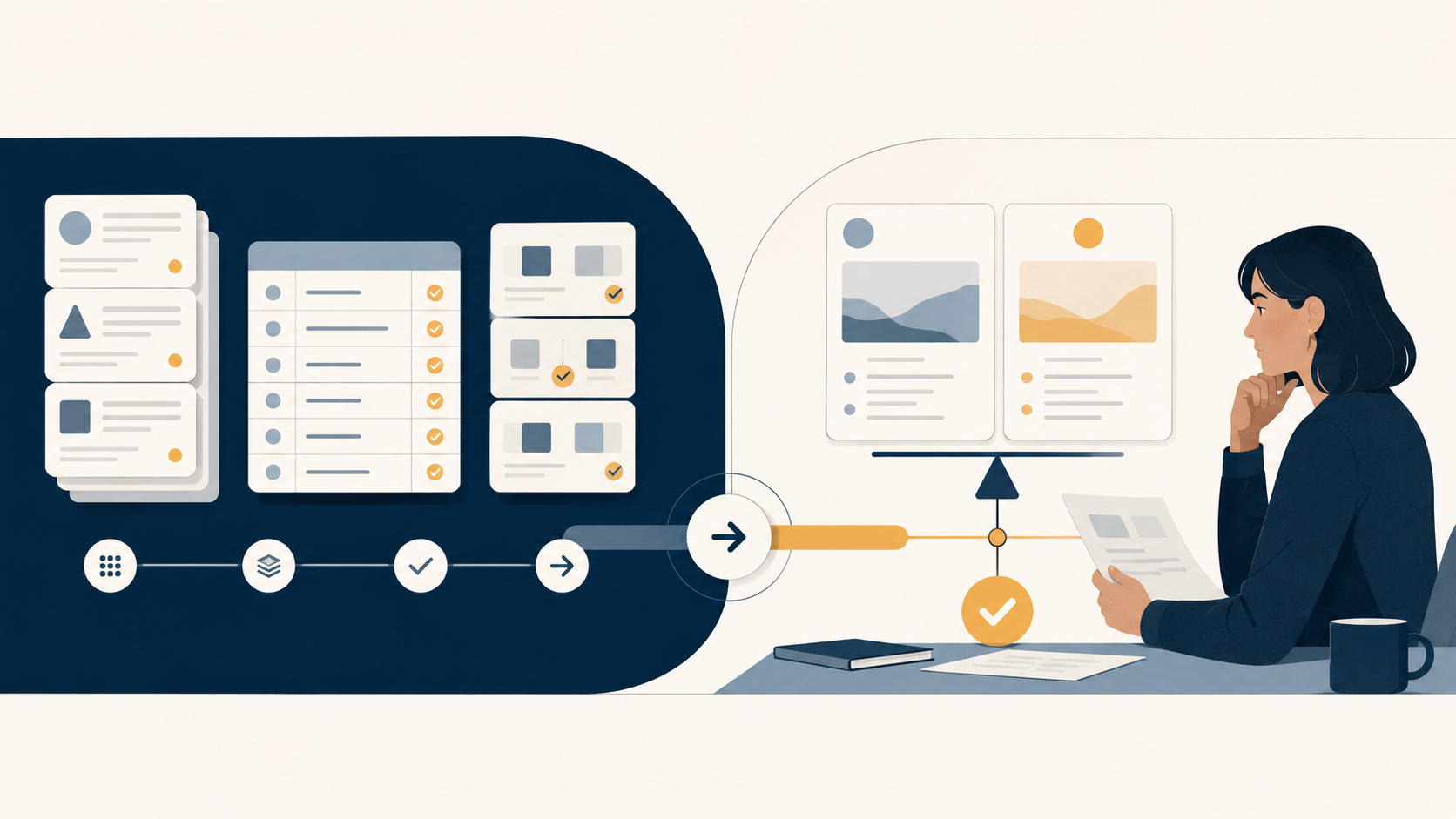
What should AI automate, and what still needs human judgement?

What should AI automate, and what still needs human judgement?
When a team first gains access to AI, the easiest work to automate tends to attract the most attention. Reports can be summarised, documents compared, emails drafted and information extracted in seconds.
The harder question arrives later: should the work have been automated in the first place?
A task may be technically possible for AI and still be a poor candidate for automation. The output might depend on context the system cannot see. A mistake might affect a customer, an employee or a regulatory decision. The person asked to review the result may lack the time or knowledge to challenge it properly.
Organisations need a clearer way to decide where AI should do the work, where it should support someone and where human judgement must remain in control.
Start with the task, rather than the job
Much of the debate around AI is framed around whole occupations. Will AI replace analysts, recruiters, accountants or customer service teams?
In practice, most jobs contain a mixture of activities. Some are repetitive and governed by clear rules. Others rely on experience, interpretation, relationships and accountability. The same finance role may include extracting figures from a report, investigating why performance changed and advising a leader on what to do next. AI could help with all three, but it should not be given the same level of responsibility for each one.
The International Labour Organization’s 2025 analysis reached a similar conclusion. Because most occupations still contain tasks requiring human input, job transformation is more likely than complete replacement.
That makes the task a more useful unit of analysis than the job title.
Four questions to ask before automating a task
A task is usually a strong candidate for automation when four conditions are present.
1. Does it happen frequently?
Automation produces more value when it removes work that people repeat regularly. Extracting the same fields from standard documents, formatting recurring reports or checking transactions against an agreed rule can consume a surprising amount of time without requiring much judgement.
A task performed once a year may still benefit from AI assistance. It is less likely to justify a fully automated process unless it is particularly slow or expensive.
2. Are the rules and inputs clear?
AI performs better when the goal is specific, the necessary information is available and the acceptable output is understood.
For example, asking AI to identify missing fields in a standard report gives it a defined job. Asking it to decide whether the report is commercially convincing requires interpretation of the audience, current priorities and the purpose of the decision.
Unclear instructions do not become clearer simply because the work is automated.
3. Can the result be checked?
An output should have a reliable method of verification. A calculation can be reconciled against source data. Extracted information can be traced back to the original document. A comparison can be checked against an agreed policy.
If nobody can explain what a correct answer would look like, the task is not ready for autonomous execution.
4. Can a mistake be corrected before it causes harm?
The consequences of an error matter as much as its likelihood.
A poorly formatted internal draft can be fixed. An incorrect recommendation that affects lending, hiring, safety or customer eligibility may be much harder to reverse. The more serious the consequence, the stronger the case for qualified human control.
These questions lead to a practical rule: automate predictable work when the result is observable and mistakes are recoverable.
What AI can reasonably take on
AI is well suited to preparing work for people. Depending on the role and the information available, that can include:
- extracting information from approved documents
- comparing figures or text against agreed criteria
- formatting and restructuring content
- preparing a first draft
- summarising material with traceable sources
- identifying defined inconsistencies or missing information
Consider a monthly finance report. AI could gather figures from approved sources, calculate agreed variances and prepare an initial commentary. The finance professional can then investigate the unusual movements, add business context and decide which issues require action.
In recruitment, AI could organise applications against transparent, job-related criteria and prepare information for review. The hiring decision still involves context, evidence and responsibility that should sit with people.
In operations, AI could detect exceptions against a known process. Someone with the right knowledge should decide whether the exception reflects an error, a legitimate edge case or a wider problem with the process itself.
The purpose is to remove predictable repetition so that people can spend more time on work that benefits from their experience.
Where human judgement still matters
Human judgement becomes essential when the work contains competing priorities, missing context or material consequences.
An AI system can compare options against the criteria it receives. It cannot decide which organisational value should take priority unless that choice has already been made and expressed in a usable way.
This matters in work such as:
- choosing between competing business priorities
- explaining why performance has changed
- deciding who to hire, promote or dismiss
- approving financial, legal or safety-critical work
- responding to an unusual situation that existing rules do not cover
- handling a sensitive conversation with an employee or customer
AI can still contribute. It might gather evidence, expose inconsistencies or show how a decision changes under different assumptions. The final interpretation and accountability should remain with someone who understands the context and can answer for the outcome.
The NIST AI Risk Management Framework places this responsibility with people and organisations. They must define what trustworthy performance means, decide acceptable thresholds and determine how risks will be managed. These choices cannot be delegated to the system being assessed.
A human in the loop does not automatically create control
Many organisations respond to AI risk by requiring human approval. That sounds sensible, but the quality of the review matters.
If the reviewer is rushed, lacks access to the underlying evidence or assumes the AI is probably correct, review becomes a procedural step. The person may approve the output without genuinely evaluating it.
Effective oversight requires three things:
- Knowledge: the reviewer understands the task well enough to identify a weak or unsupported answer.
- Time: they have enough space to inspect the evidence rather than scan the conclusion.
- Authority: they can reject the output, request more information or stop the process.
The NIST Generative AI Profile recommends clearly defined roles and responsibilities for human oversight. This distinction is important because accountability cannot be added at the end of a process. It has to be designed into the way the work is performed.
A better division of work
The most effective relationship between people and AI will often be collaborative.
AI can prepare information, compare it against defined criteria, draft material and check for known issues. People can set the objective, interpret the context, resolve trade-offs and approve decisions with significant consequences.
The boundary will differ between organisations and roles. A task that is safe to automate in one environment may require close supervision in another because the data, regulation or potential impact is different.
It will also move over time. As a process becomes better understood and verification improves, more of it may be automated safely. New risks or unusual cases may require people to take parts of the work back.
This is why organisations need more than a list of approved tools. Teams need clear task boundaries, reliable methods of checking output and people who know when to challenge the system.
The missing capability is judgement
The World Economic Forum’s Future of Jobs Report 2025 found that employers expect 39% of workers’ core skills to change by 2030. Teaching people how to operate an AI interface addresses only a small part of that shift.
Employees also need to learn how to:
- decide which parts of a task to delegate
- provide the context AI needs
- verify claims, calculations and sources
- recognise when the output is plausible but unsupported
- understand when human judgement must take over
Those capabilities develop through practice. Generic examples can introduce the concepts, but they cannot show how the boundary works inside a finance report, a claims review, a workforce decision or an operational process.
This is where Etiq focuses. People learn through tasks connected to their role, using realistic organisational context. An AI tutor supports the work, while verification checks the resulting output and shows where capability is improving. Leaders gain evidence of what people can do, rather than relying only on course completion or tool usage.
The goal is not to keep people involved in every AI-assisted task. It is to make sure that when human judgement matters, the person responsible is equipped to use it.
Decide the boundary before scaling the tool
AI can remove work that people should not have to repeat. It can prepare better information and give skilled employees more time for interpretation, decisions and relationships.
Those benefits depend on choosing the boundary carefully.
Before automating a task, ask whether it is frequent, clearly defined, verifiable and recoverable. Then ask whether the person overseeing it has the knowledge, time and authority to intervene.
If those conditions are present, AI can take on more of the work with confidence. If they are missing, automation may simply move risk further into the process and make it harder to see.
The question for each team is practical: what could AI take off your plate tomorrow, and what would you still refuse to delegate?